
How To Build A Bee Bank
(A nesting site for ground-nesting bees)
By Rowan Sidnell
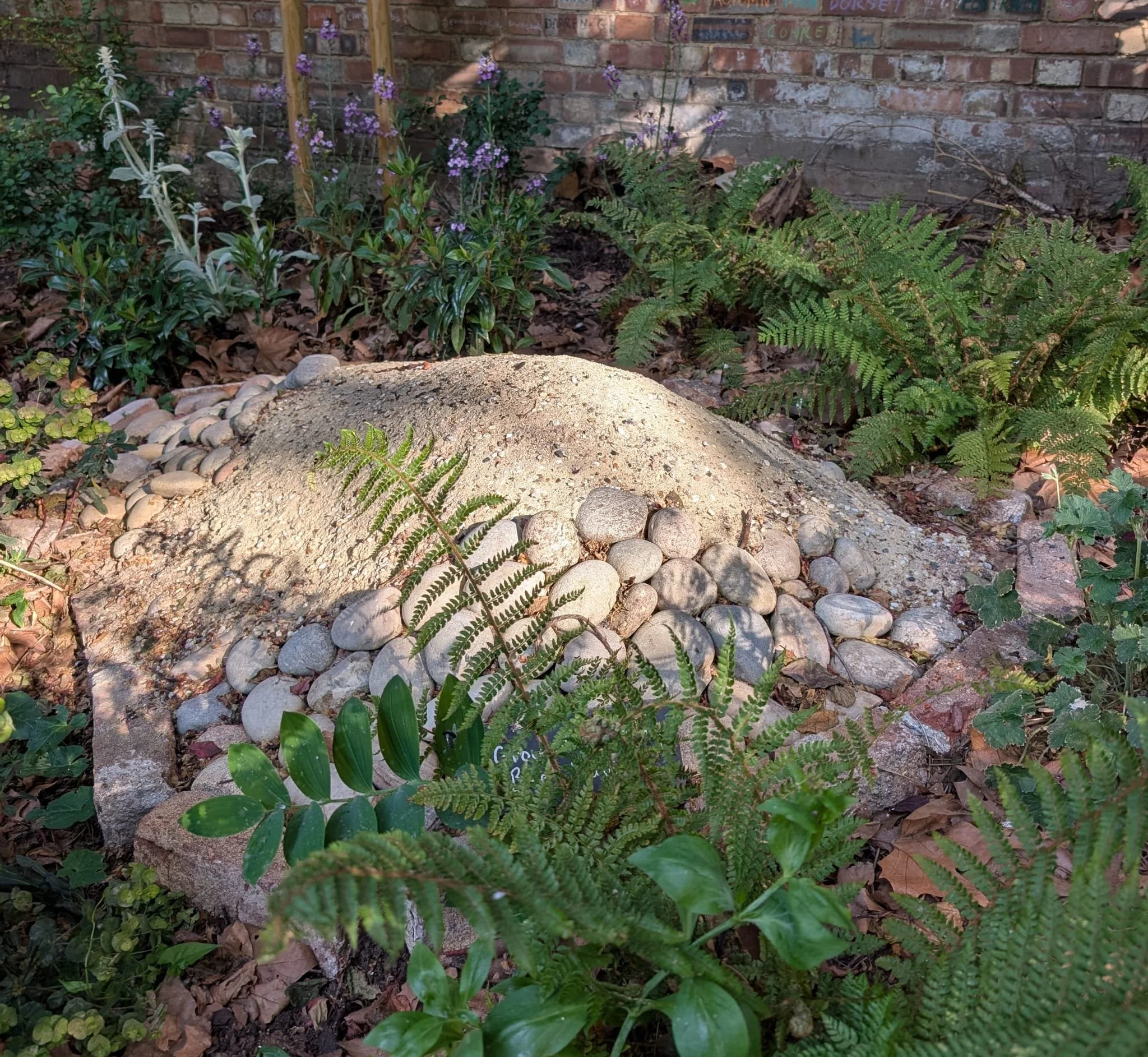
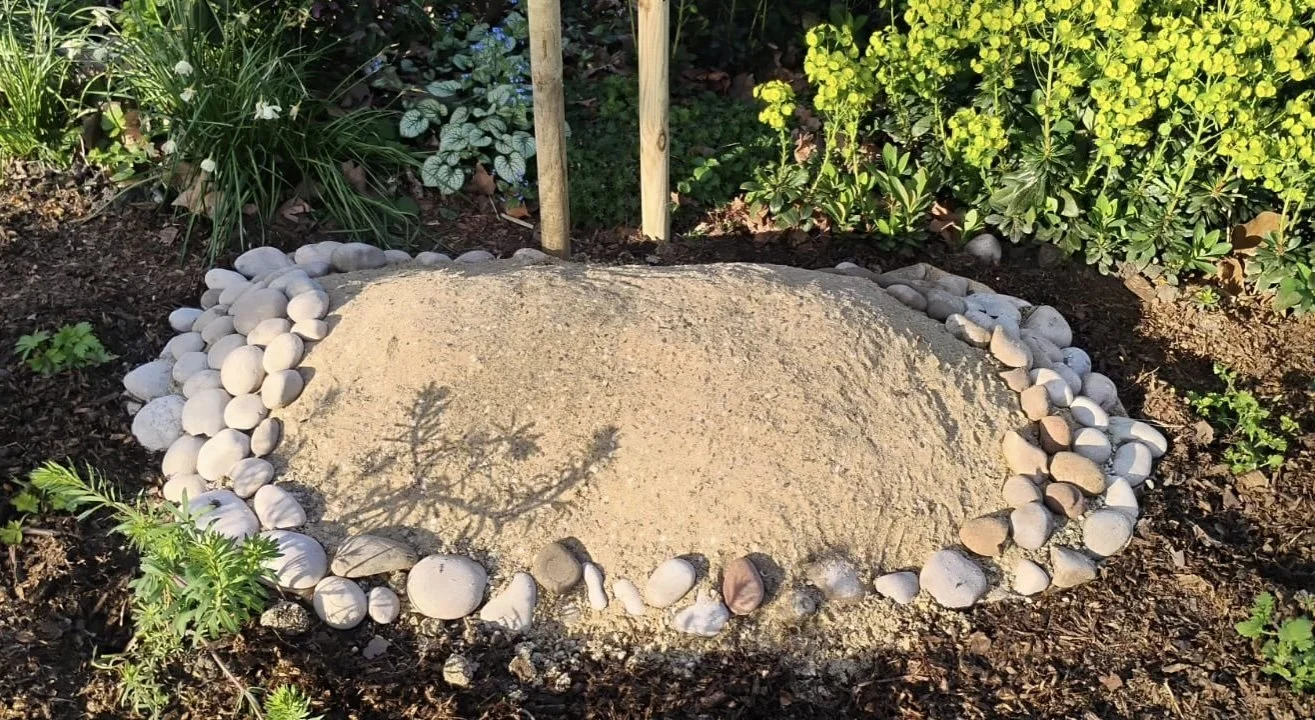
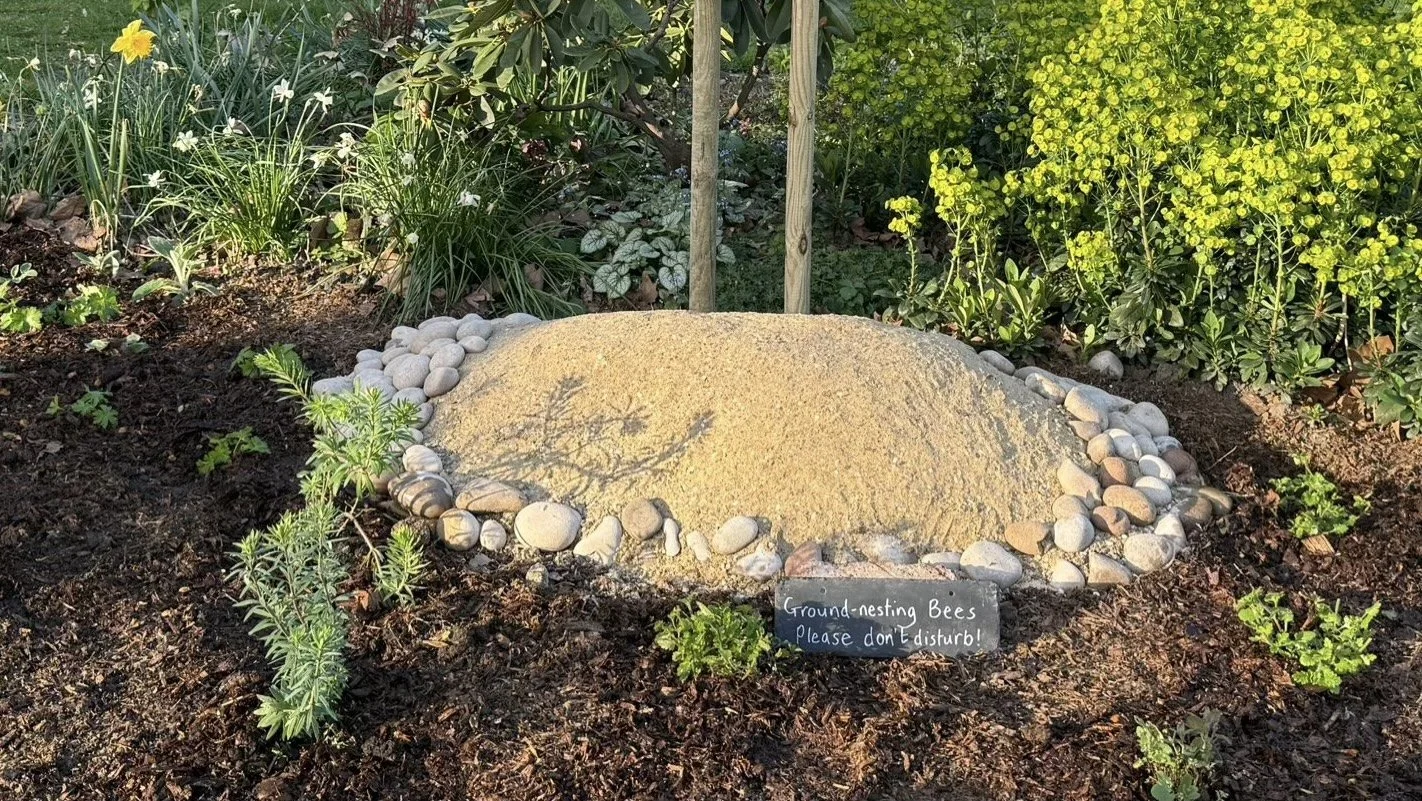
Bee Bank St John’s Garden - Photo by Analisa Plehn
What are ground-nesting bees?
In the UK, around 250 of our approximately 270 native bee species are solitary (Maher et al., 2019; Falk, 2019), meaning they do not live in hives and produce no wax or honey. Over the spring and summer months, female solitary bees mate with males and then work alone to collect nectar and pollen for their offspring before leaving their larvae to develop inside individual nest chambers called brood cells. The bee larvae develop and pupate within their brood cells, emerging as adult bees in the following spring. Of these solitary bees, ~70% of them create their nests underground (Kew website, Solitary Bees).
One of the main factors that determines the success of solitary bees is the availability of nesting resources (Gathmann and Tscharntke 2002; Potts et al., 2005). For a large number of ground-nesting bees, this is in the form of bare soil, with the most important features being the temperature and soil characteristics (Maher et al., 2019). While there is variation in what each species needs, generally loose, sandy soils are preferred (Sardiñas and Kremen 2014; Potts & Willmer), with some species preferring south-facing ground that is sloped (Maher et al., 2019; Falk, 2019; Potts and Willmer, 1997). Slope, south-facing, bare earth has the advantage of maximised sun exposure and therefore nest temperatures. Larval growth and development are positively related to nest temperature (up to a point), and the higher temperature at the nest entrance also makes foraging easier for the mother bee (Potts and Willmer, 1997).
We also know that bees are affected by small-scale habitat changes. This means that if the resources they need are within a few hundred metres of each other, this can have a dramatic impact on their ability to succeed in that habitat (Gathmann and Tscharntke 2002; Grundel et al., 2010). This is good news as it means that creating suitable sites for native bees is an achievable goal for local communities in urban areas. This guide gives step-by-step instructions on how to create a nesting site for ground-nesting solitary bees (a bee bank). For more information on other ways to support native bees and other vital insect pollinators, see the Clerkenwell Pollinator Toolkit available on the St John’s Garden website.
How to make a Bee Bank
You can download a Quick Guide PDF for easy printing.
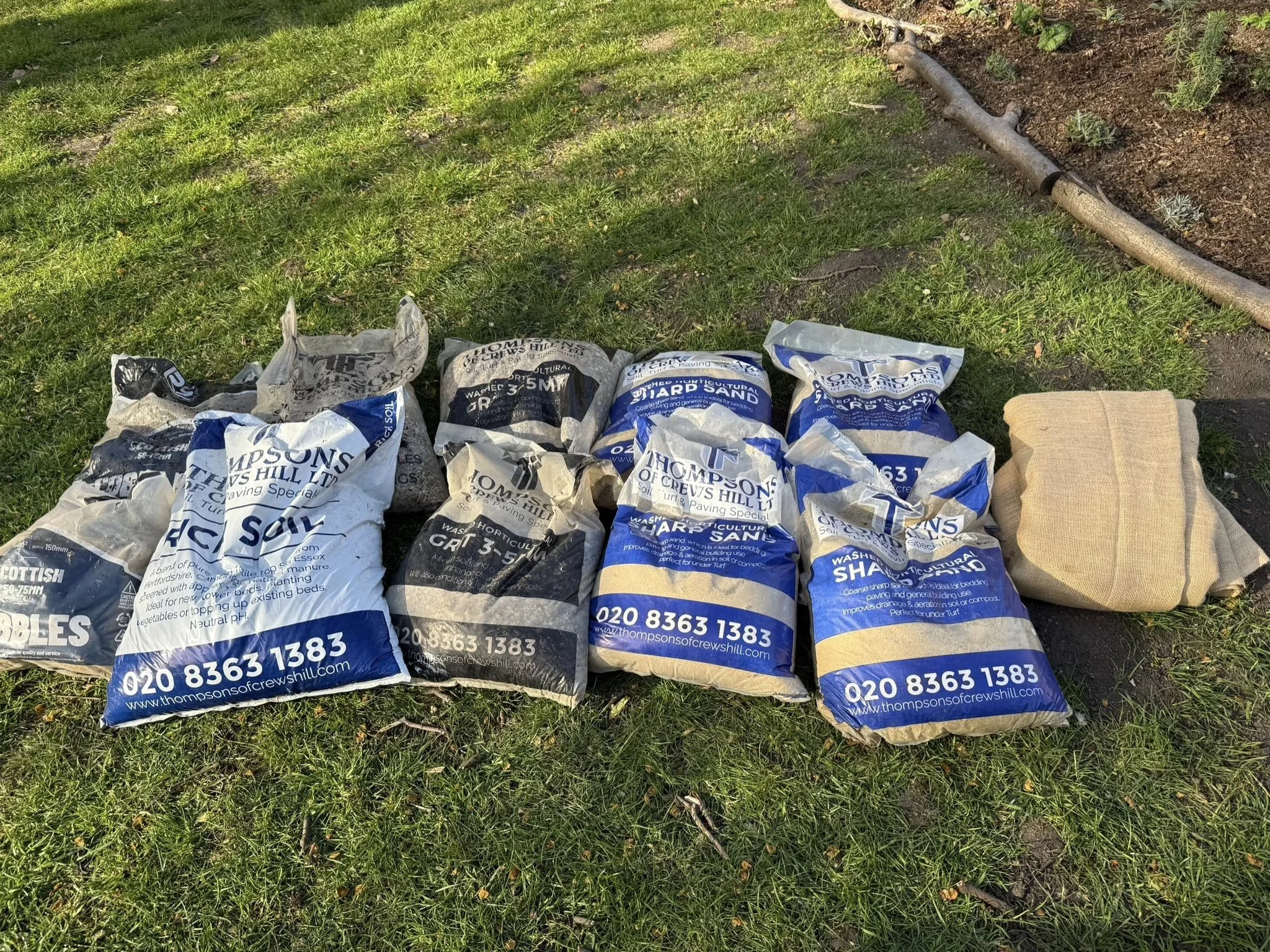
Tools
Scissors
Shovel
Large container for mixing (e.g. wheelbarrow)
Water spray
Weather-resistant pen
Materials
For base layer
Hessian/jute fabric material 1m x 1m
Garden gravel 2 x 20kg bags
For sand bank
Sharp sand 4 x 20kg bags
Fine angular gravel 2 x 20kg bags
Low-fertility topsoil 1 x 20lt bag
For edging and topping
Cobbles 50–75mm 3 x 20kg bags
For information
A weatherproof sign eg slate or painted wood
Instructions
Find a sunny, sheltered spot facing South. It should be protected from disturbance from people and animals.
Remove existing vegetation, roots and other debris to create a bare patch of ground measuring 1x1m - you can get creative with the shape as long as there’s a good sized South-facing side.
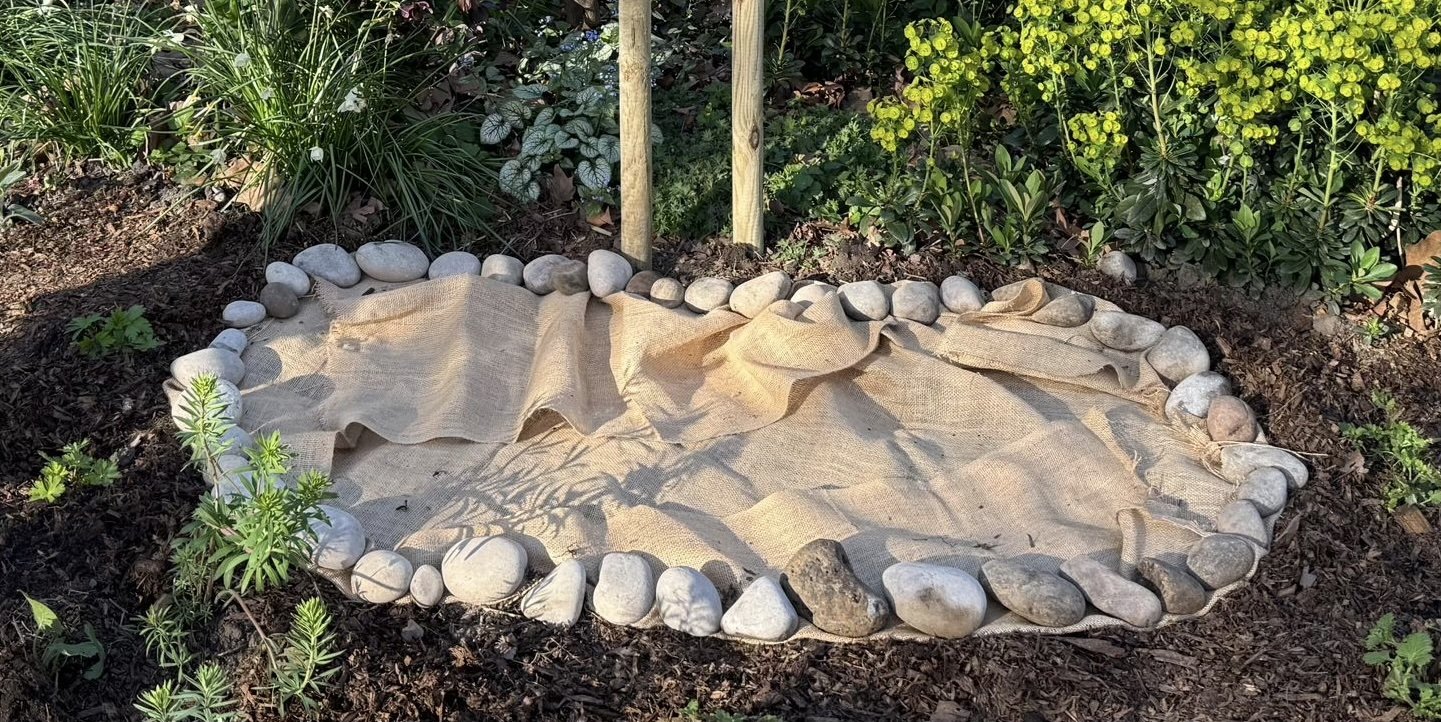
Cut the jute matting to size and lay it down on your patch of bare ground.
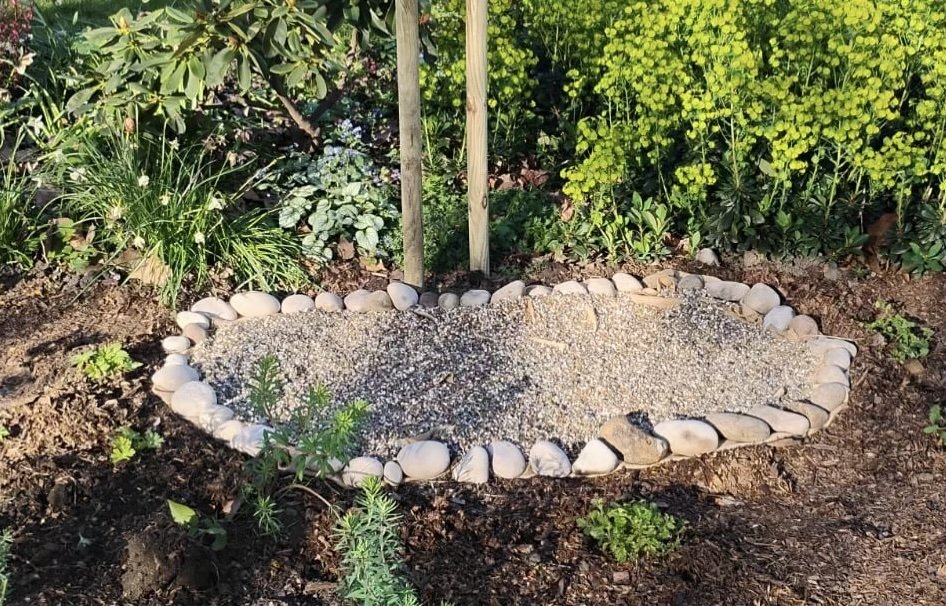
Use bricks, stones, logs or wooden sleepers to create an edge around the area and build up a South-facing slope. This has the effect of increasing the soil temperature on the South-facing side as well as improving drainage. The edges help prevent accidental trampling and make the habitat aesthetically pleasing. The stones or other edging materials should sit on top of the matting.
Add a 5cm-deep layer of gravel for drainage.
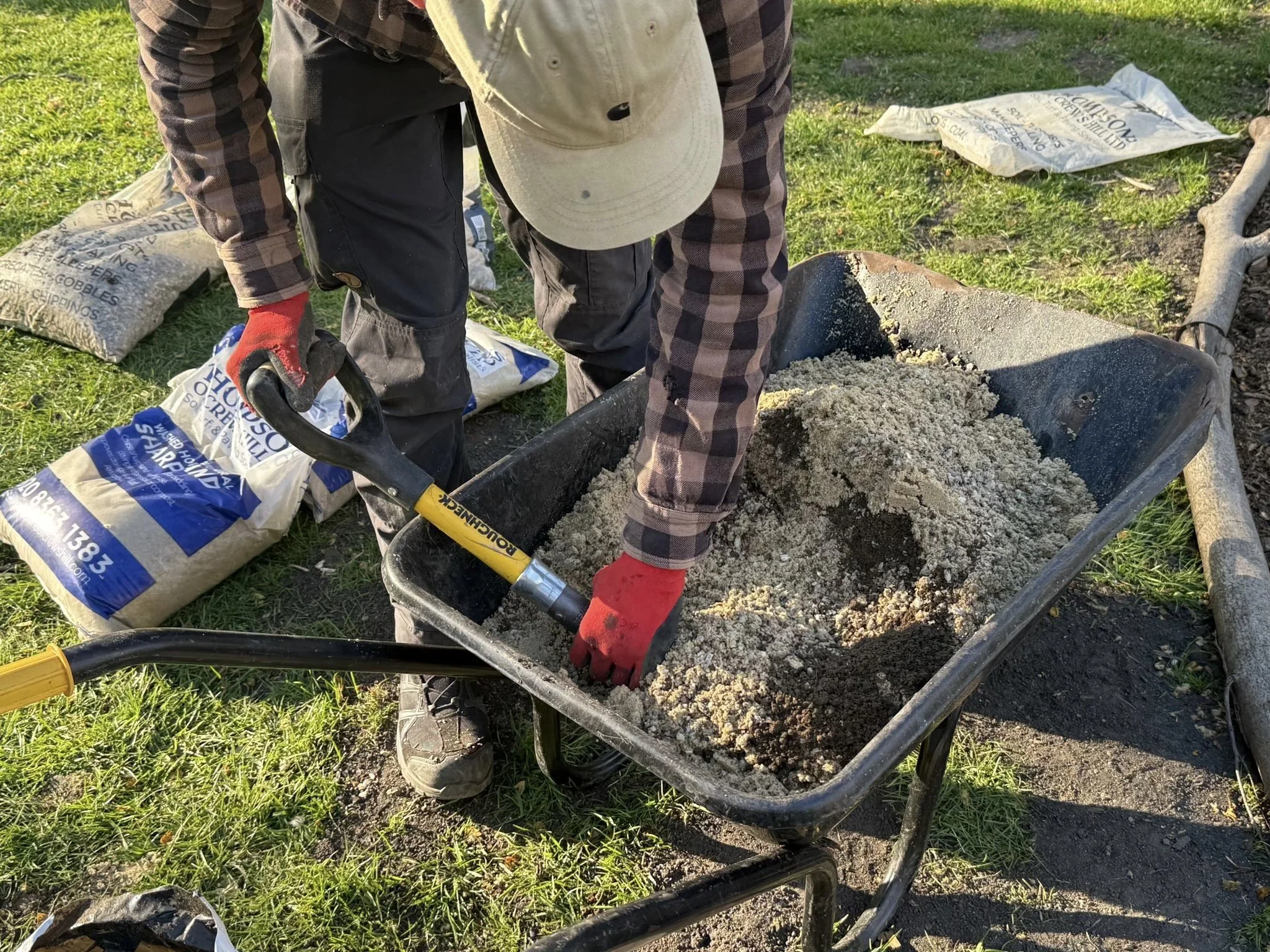
Mix sand, fine-angular gravel, and low-fertility top soil in a ratio of 4:2:1. The top soil can be from the area you cleared, although soils rich in organic material should be avoided. Mixing a portion of the materials in a wheelbarrow. With the quantities listed above, this fills a wheelbarrow 4 times. Mix in the correct ratios within each batch.
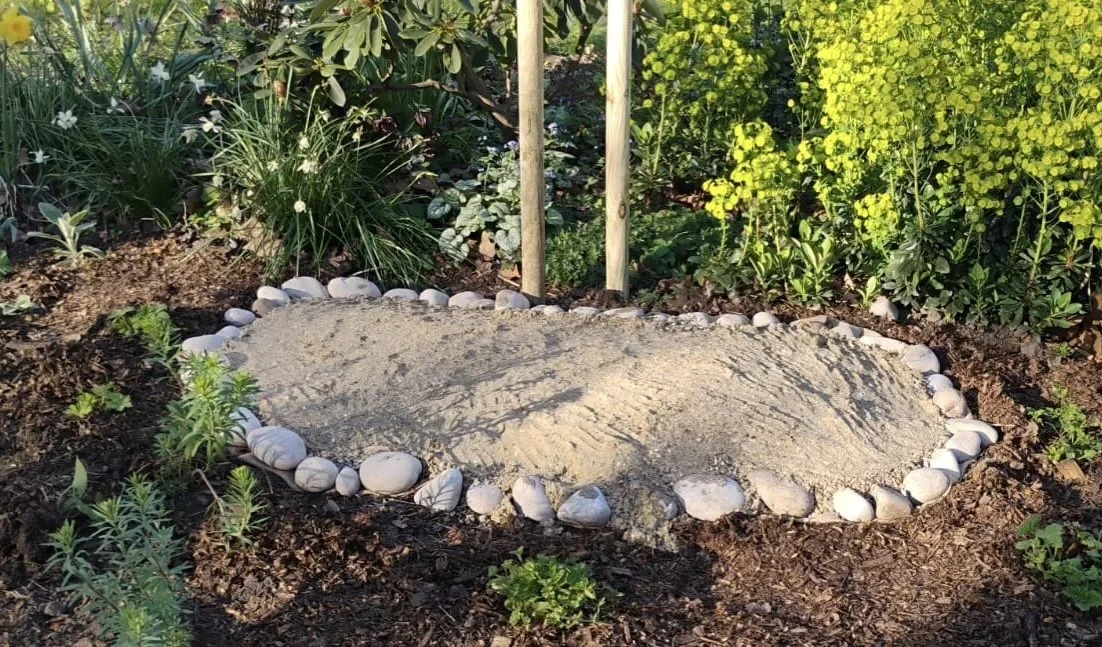
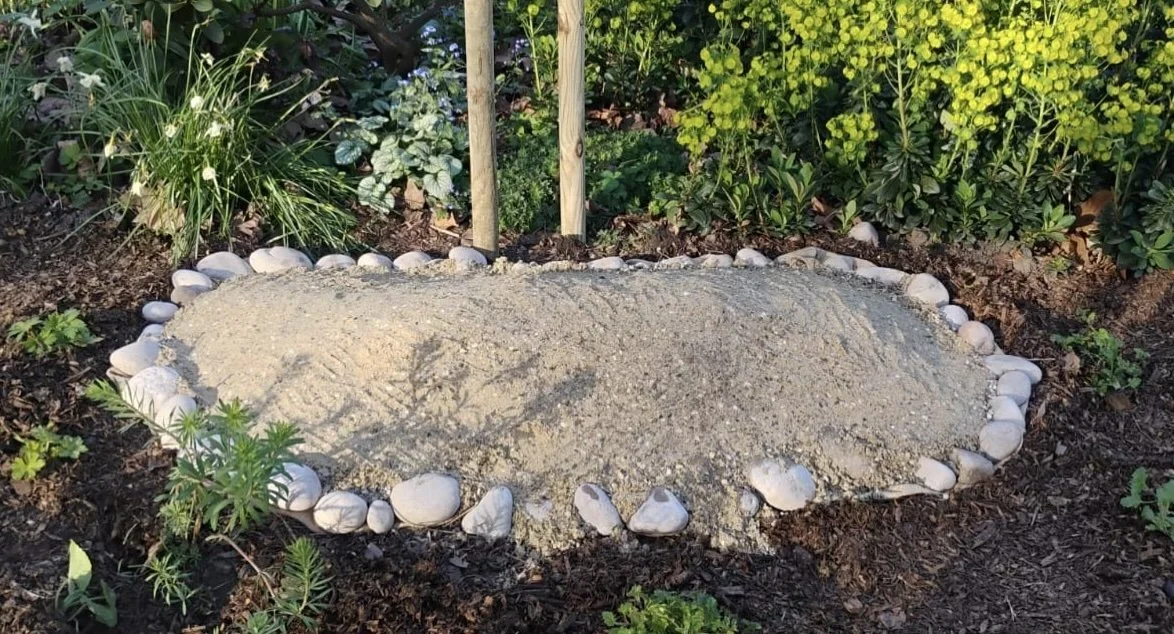
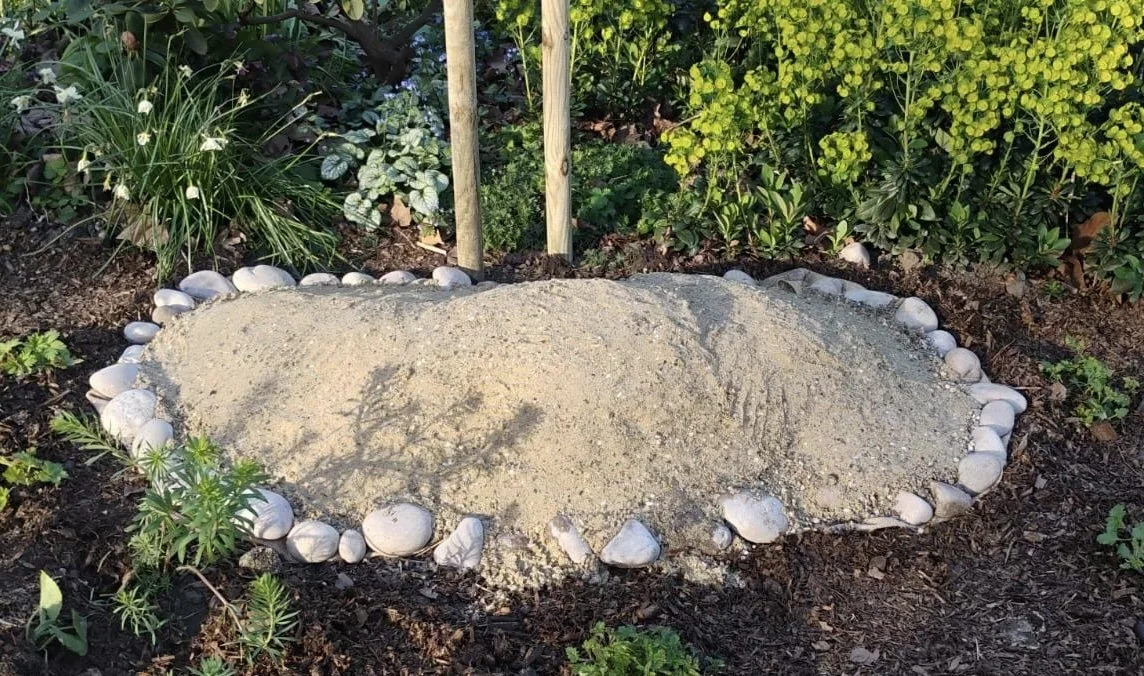
Add this substrate mix to the area layer by layer to a height of at least 40cm. If you add a wheelbarrow of mix at a time, that will give you four layers using the quantities listed above. Before adding the next layer, compress the mound by spraying with warm water and pressing with your hands or a tile. Do this several times on the top layer over multiple days. Compaction makes this a more robust substrate for bees to tunnel in and prevents disintegration of the mound. Building up the sandy mound in a series of compacted layers.
Place cobbles on the finished mound in a pleasing pattern which covers half to a third of the area. These increase heat retention within the mound, which is favourable for larval development. Bees sometimes construct their nests directly beneath or next to stones, potentially for the temperature boost and/or protection from parasites (Potts and Willmer, 1997). Stones can also serve as landmarks for bees returning to their nests (Collett and Zeil, 1997; Brünnert et al., 1994).
Provide a shallow water source nearby with pebbles for bees to land on. It is known that honeybees drink compound-rich (“dirty”) water to access minerals such as sodium (Bonoan et al., 2017); we assume that these nutrients are also important for solitary bees.
Add a patch of pollinator-friendly plants within a few metres of the mound e.g. wallflower, hardy geranium or lungwort to provide nectar and pollen (sugar and protein), which feed both adult bees and their larvae when they hatch.
If the bee bank is in a public space, add a sign stating what this area is for e.g. “Bees nest here” or “Ground-nesting bees, please don’t disturb”. If you think the bee bank might cause alarm then mention “these are gentle bees and don’t sting people”. A hand-written sign makes it clear there are regular people who are caring for the bank.
(Optional) Include additional information on native bees or link to information via a QR code, e.g. “Did you know? There are 270+ species of bee in the UK and the majority nest underground!”
Maintaining the bee bank
Keep the area free of vegetation and falling leaves, carefully removing leaves by hand and pulling sprouting plants when they are small seedlings to ensure minimal disturbance to the soil surface.
Don’t plant anything in front of the habitat that could lead to an increase in shade.
Maintain or erect fences, dead hedges or stepovers around the habitat to prevent trampling or disturbance, which can destroy nests.
Plant and maintain a variety of flowering plants nearby that will bloom consecutively throughout the year, feeding native bee species throughout their flight seasons (e.g. heather and asters in autumn, hellebore in winter, rosemary and lungwort in spring, lambs ’ ear and foxgloves in early summer, salvia and campanula in summer). Consult the Clerkenwell Pollinator Toolkit & its Resources section for planting lists through the seasons.
Keep the water source filled, especially in dry periods, so that bees have somewhere to drink and cool down.
Use the UK PoMS Flower-Insect Timed Countapp or iNaturalist app monthly to record which bees you observe in the area.
What to expect
Local foxes digging up parts of the mound within days of installation. This year in Clerkenwell, entomologists are recording percentage disturbance across each bee bank to understand how it impacts occupancy rates.
Bees hibernating in the mound from October, as well as other invertebrates using it for shelter.
Bees nesting from early Spring to late Summer. See below for a list of possible bee species.
Occupancy rates increasing as the Spring and Summer progress. Consider monitoring monthly.
Ground-nesting species that may use the bee bank
The following are the top five ground-nesting bee species identified along the Clerkenwell Pollinator Path during a pollinator survey in 2025 (Tsiolis, 2025). Consider searching for a species in iNaturalist, selecting the “Map” tab and zooming in on your area to see if there have been any local sightings. Note that no recorded sightings does not mean there are no bees present. Species descriptions from Steven Falk’s Field Guide to the Bees of Great Britain and Ireland (2019).
A note on nest visibility: as a bee excavates a nest, she produces a small pile of earth called a tumulus. This will only be visible for a short period of time; it is often washed away by rain. The entrance to the nest may remain visible as a circular hole with clear edges.
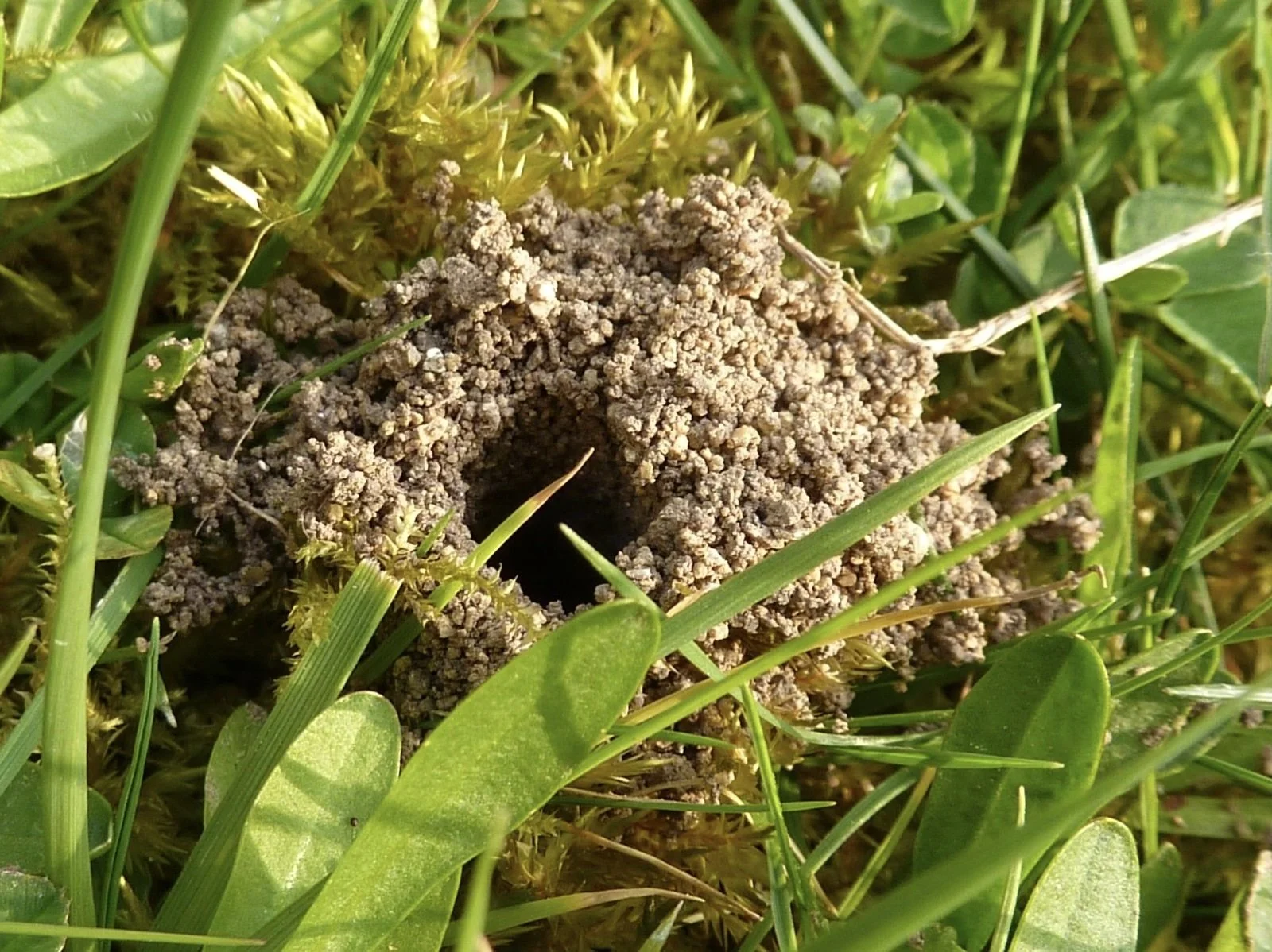
Tumulus at the entrance of an Andrena fulva (tawny mining bee) nest (Sarah, 2011).
1. Common furrow bee (Lassioglossum caleatum) or Bloomed furrow bee (Lassioglossum albipes).
Almost indistinguishable from one another, although L. calceatum is more widespread in the UK.
Common furrow bee 8-10mm,
Bloomed furrow bee 6.5-9.5mm
Flight season: March-October (F), July-October (M)
Light brown hairs on the thorax, rather bare banded abdomen (F)
Dark brown or red abdomen (appears slightly translucent) (M)
L. calceatum males have hairier abdomens than L. albipes males
2. Hairy-footed flower bee (Anthophora plumipes)
10-11m
Flight season: late Feb-May (M), March-June (F)
Black body with orange hind legs (F)
Orange thorax with black tip of abdomen (M)
Nests in vertical soil faces and walls
3. Four-banded flower bee (Anthophora quadrimaculata)
7-8.5mm
Sandy brown hairs on thorax, wide bands of dark brown on abdomen
Nests in South-facing slopes of sandy soil
4. Green-eyed flower bee (Athophora bimaculata)
Nests in exposed sandy soils on sloped surfaces
Often nest in aggregations
Flight season: late June-September
Thick sandy brown hair on legs, dark brown thorax and abdomen with bands of sandy brown hair on abdomen
Large yellow patch on face (M)
Small yellow patch on face, slightly larger body size (F)
5. Hairy yellow-faced bee (Hylaeus hyalinatus)
Flight season: May-Sept
4-4.5mm (F), 3.5-4.5mm (M)
Black with some yellow facial markings (more pronounced in M)
May nest in deadwood as well as soil
Sources
Bonoan, R.E., Tai, T.M., Tagle Rodriguez, M., Feller, L., Daddario, S.R., Cjaza, R.A., O'Connor, L.D., Burruss, G. and Starks, P.T. (2017), Seasonality of salt foraging in honey bees (Apis mellifera). Ecol Entomol, 42: 195-201. https://doi.org/10.1111/een.12375
brainspuddle, 2013. Lasioglossum albipes male. Available at:https://www.flickr.com/photos/drinkermoth/9641689728/ Date accessed: 21/04/2026.
Brünnert, U., Kelber, A. & Zeil, J. Ground-nesting bees determine the location of their nest relative to a landmark by other than angular size cues. J Comp Physiol A175, 363–369 (1994). https://doi.org/10.1007/BF00192995
Collett, T.S., Zeil, J. (1997). The selection and use of landmarks by insects. In: Lehrer, M. (eds) Orientation and Communication in Arthropods. EXS, vol 84. Birkhäuser, Basel. https://doi.org/10.1007/978-3-0348-8878-3_2
Falk, S. (2019). Field guide to the Bees of Great Britain and Ireland. Bloomsbury.
gailhampshire, 2016. Hairy-footed Flower Bee . Anthophora plumipes, female. Anthophora plumipes - Flickr - gailhampshire.jpg. Available at: https://commons.wikimedia.org/wiki/File:Hairy-footed_Flower_Bee_._Anthophora_plumipes,_female._Anthophora_plumipes_-_Flickr_-_gailhampshire.jpg Date accessed: 21/04/2026.

Gathmann, A. and Tscharntke, T., 2002. Foraging ranges of solitary bees. Journal of animal ecology, 71(5), pp.757-764.
growwild.kew.org. (n.d.). Solitary bees | Grow Wild | Kew. [online] Available at: https://growwild.kew.org/championing-nature/pollinators/solitary-bees. [Accessed 18 Mar 2026].
Grundel, R., Jean, R.P., Frohnapple, K.J., Glowacki, G.A., Scott, P.E. and Pavlovic, N.B., 2010. Floral and nesting resources, habitat structure, and fire influence bee distribution across an open‐forest gradient. Ecological applications, 20(6), pp.1678-1692.
How to create solitary bee nest sites on your farm Protecting Farmland Pollinators Action Sheet 1. (n.d.). Available at: https://biodiversityireland.ie/app/uploads/2022/05/ActionSheet_Solitary-Bees-WEB-2.pdf
Leidus, I., 2016. Anthophora bimaculata - Jasione montana - Tallinn.jpg. Available at: https://commons.wikimedia.org/wiki/File:Anthophora_bimaculata_-_Jasione_montana_-_Tallinn.jpg Date accessed: 20/04/2026

Maher, S., Manco, F. and Ings, T.C., 2019. Using citizen science to examine the nesting ecology of ground‐nesting bees. Ecosphere, 10(10), p.e02911.
Miridae.com. (2025). The Ground Nesting Bee Project. [online] Available at: https://www.miridae.com/the-ground-nesting-bee-project. [Accessed 18 Mar. 2026].
Orangeaurochs, 2015. Male hairy-footed flower bee (Anthophora plumipes), Sandy, Bedfordshire (16870981377).jpg. Available at: https://commons.wikimedia.org/wiki/File:Male_hairy-footed_flower_bee_%28Anthophora_plumipes%29,_Sandy,_Bedfordshire_%2816870981377%29.jpg . Date accessed: 21/04/2026.
,_Sandy,_Bedfordshire_(16870981377).jpg)
People’s Trust for Endangered Species. (2022). How to make a habitat for ground nesting bees - PTES. [online] Available at: https://ptes.org/my-garden/how-to-make-a-habitat-for-ground-nesting-bees/ [Accessed 18 Mar. 2026].
Personal communication with Tsiolis, K. (2025). Email to Dr Sarah Wood.
Potts, S. and Willmer, P. (1997), Abiotic and biotic factors influencing nest-site selection by Halictus rubicundus, a ground-nesting halictine bee. Ecological Entomology, 22: 319-328. https://doi.org/10.1046/j.1365-2311.1997.00071.x
Potts, S.G., Vulliamy, B., Roberts, S., O'Toole, C., Dafni, A., Ne'eman, G. and Willmer, P., 2005. Role of nesting resources in organising diverse bee communities in a Mediterranean landscape. Ecological Entomology, 30(1), pp.78-85.
Sardiñas, H.S. and Kremen, C., 2014. Evaluating nesting microhabitat for ground-nesting bees using emergence traps. Basic and Applied Ecology, 15(2), pp.161-168.
Sabroe, L., 2014. Anthophora quadrimaculata male (16741143722).jpg. Available at: https://commons.wikimedia.org/wiki/File:Anthophora_quadrimaculata_male_%2816741143722%29.jpg Date accessed: 21/04/2026
.jpg)
Sarah, Tawny mining bee nest - Andrena fulva. Available online at: https://commons.wikimedia.org/wiki/File:Tawny_Mining_Bee_nest_-_Andrena_Fulva_2d.jpg. Date accessed: 26/03/2026

Tsiolis, 2025. Clerkenwell Pollinator Path Report of Pollinator and Habitat Surveys 2025. Available at: https://static1.squarespace.com/static/689c58eb5454043d351368aa/t/69b028854273cf7ef85bc08e/1773152389043/PLT+Clerkenwell+report_2025_KT_HBM_SW.pdf
tyt.lt, 2009. Lassioglossum calceatum female. Available at: https://tyt.lt/picture/9404/category/2624-lasioglossum-calceatum-vagabite Date accessed: 20/04/2026.
van Dam, A., 2009. Hylaeus hyalinatus.jpg. Available at: https://commons.wikimedia.org/wiki/File:Hylaeus_hyalinatus.jpg Date accessed: 22/04/2026.
