
Susanna's Wildlife Watch - December
Biodiversity Update Dec 2025: One of the most exciting bird sightings in St John’s Garden recently has been a Great Spotted Woodpecker. We heard its sharp ‘kik, kik’ call last Friday morning, quickly switched on Merlin app, and realised - a woodpecker! From the sycamore tree, the woodpecker flew to one of the plane trees, where it hammered away for a minute or two, working its way up the higher branches. What a brilliant sight! Great Spotted Woodpeckers are very striking birds, with black, white and red markings. They hammer on wood to winkle out grubs to eat, and to make nest holes.
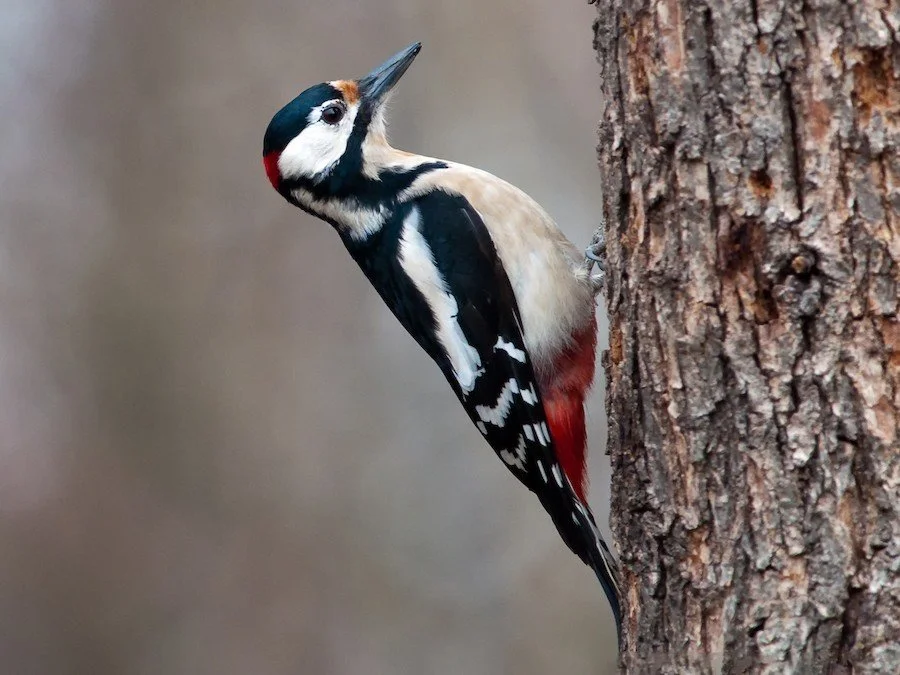
Male (Great Spotted)© Charles Thomas
It’s amazing to me that woodpeckers can live here in central London. I checked eBird records, and in our neighbourhood over the past three years Great Spotted Woodpeckers are seen regularly at Bunhill Fields, which seems to be a stronghold for the species - I’ve walked over there a few times to see if I can see one, and almost always do. Then there are scattered woodpecker sightings across central London, in quite surprising places, such as at Tate Modern for example, and at Victoria Gardens on the Embankment. Across Europe, Great Spotted Woodpeckers are actually doing quite well, with the population stable or even increasing, apparently due to the planting of new woodland and to greater availability of dead wood, possibly because of Dutch Elm disease. And Greater Spotted Woodpeckers are not fussy about which types of trees they live in, which is also a help. Wikipedia says however that the species was “challenged by the fragmentation of woodland”. I dug around to understand more about that, and found a super EU report about how Great Spotted Woodpeckers were saved in Tenerife. In the 1990s they had dwindled there to only 100 pairs, suffering from lack of dead wood, and lack of drinking water. But after forestry management practices were changed to leave some dead trees in place, and after drinking water troughs were provided, Tenerife’s woodpeckers were saved. It was a brilliant piece of work that had had knock-on benefits for other species too (and for people! all really enjoyable as these birds are so charismatic). It is thought-provoking actually, when you look at our neighbourhood… Anyway, it is marvellous that a woodpecker has discovered St John’s Garden. Of course we hope they’ll be back! Keep an eye out! And an ear!
The woodpeckers are one of 20 bird species that have been recorded in St John’s Garden this past year. The 20 species are Blackbird, Black Redstart (our superstars), Blue Tit, Carrion Crow, Common Wood-Pigeon, Dunnock, Goldfinch, Grey Wagtail, Herring Gull, Kestrel (wow!), Lesser Black-backed Gull, Great Spotted Woodpecker (new arrival! yay!), Great Tit, Magpie, Robin, Rock Pigeon (ie plain old pigeons), Rose-ringed Parakeet, Woodcock (amazing!), White Wagtail and Wren. Over 120 checklists have now been submitted on our eBird Hotspot since we set it up two years ago, with eight people submitting sightings. The hotspot allows everyone’s sightings to be recorded together, to piece together and share the story of what is happening on our little patch. This past year, the leading birder at the St John’s Garden Hotspot is Marcin Kempa, who has submitted 27 checklists. Bravo Marcin! Anyone can join in - check out the eBird app and get started, or just enjoy the Hotspot, which is here.
Meanwhile, in the insect world, the Clerkenwell Pollinator Path project results will be unveiled at an event at The Charterhouse on Monday, December 8th. Over the summer, led by Pollinating London Together, the project gathered scientific survey data about bees, wasps and hoverflies etc from over a dozen green spaces across our neighbourhood. The Charterhouse event is sold out but you don't need to miss out, because thanks to a brilliant push on the St John's Garden instagram to get us to over 1000 subscribers (amazing!), the event will be streamed live on Instagram @stjohnsgarden.ec1 at 6pm. As well as the survey results, the team will be sharing recommendations for supporting pollinators in 2026. So see you there!
And finally, let’s talk pondlife! It is now a year since the wildlife pond was established in St John’s Garden. At the start, the pond was basically a tank full of tap water. We planted it up, and then have largely let nature take its course, to see what would happen... We test the water regularly for clarity and for acidity, and monitor what living creatures arrive, dipping the pond with a net and looking for the presence or absence of specific ‘indicator species’. In the first months, we saw only midge larvae and mosquito larvae, which are low-level indicator species, wriggly things that can survive in any grubby puddle, and which each score 1 ‘pond health’ point. So the pond was in the lowest “could be improved” category. Not surprising, as it was new. In July we saw lesser water boatmen, an indicator species that scores 5 points, raising the pond total score to the middle category of “quite healthy”. This was a great milestone achieved. Through the year we also found hoverfly larvae, water fleas, mosquito pupae, and recently also tiny copepods, which are all encouraging signs. The next big milestone is 30 points, which will mean the pond is "very healthy." To get there will take time, and we’ll need some of the fussiest creatures such as dragonfly larvae to discover St John’s Garden, and thrive here... Wouldn’t it be amazing to have dragonflies skimming over our pond... Well, we’ll keep watching, and see what happens…