Susanna’s Wildlife Watch - June
In May we had a go at our (first ever!) St John’s Garden community “BioBlitz”. The idea of Bioblitzes began in the 1990s when US National Park Service rangers had the idea of organising public events, aiming to discover as many wild things as possible in a defined area within a short timeframe. They did a 24-hour marathon event and got 1000 species! Our first bioblitz wasn’t quite on that scale! But we gathered on Weds 20th May ready for the start at 4pm, aiming to see how many species of wild birds, plants, insects, fungi and so on we could record in St John's Garden in two hours before the clock stopped at 6pm sharp. Observer numbers were brilliantly boosted by volunteers from Queens College London, and Dr Clara Montgomery and her team of students from the Biological Sciences department of Queen Mary University London, who arrived with insect nets and collecting pots. To record species, we used the iNaturalist app, which meant that no knowledge of wildlife was required! Just a phone in hand, and eyes peeled!
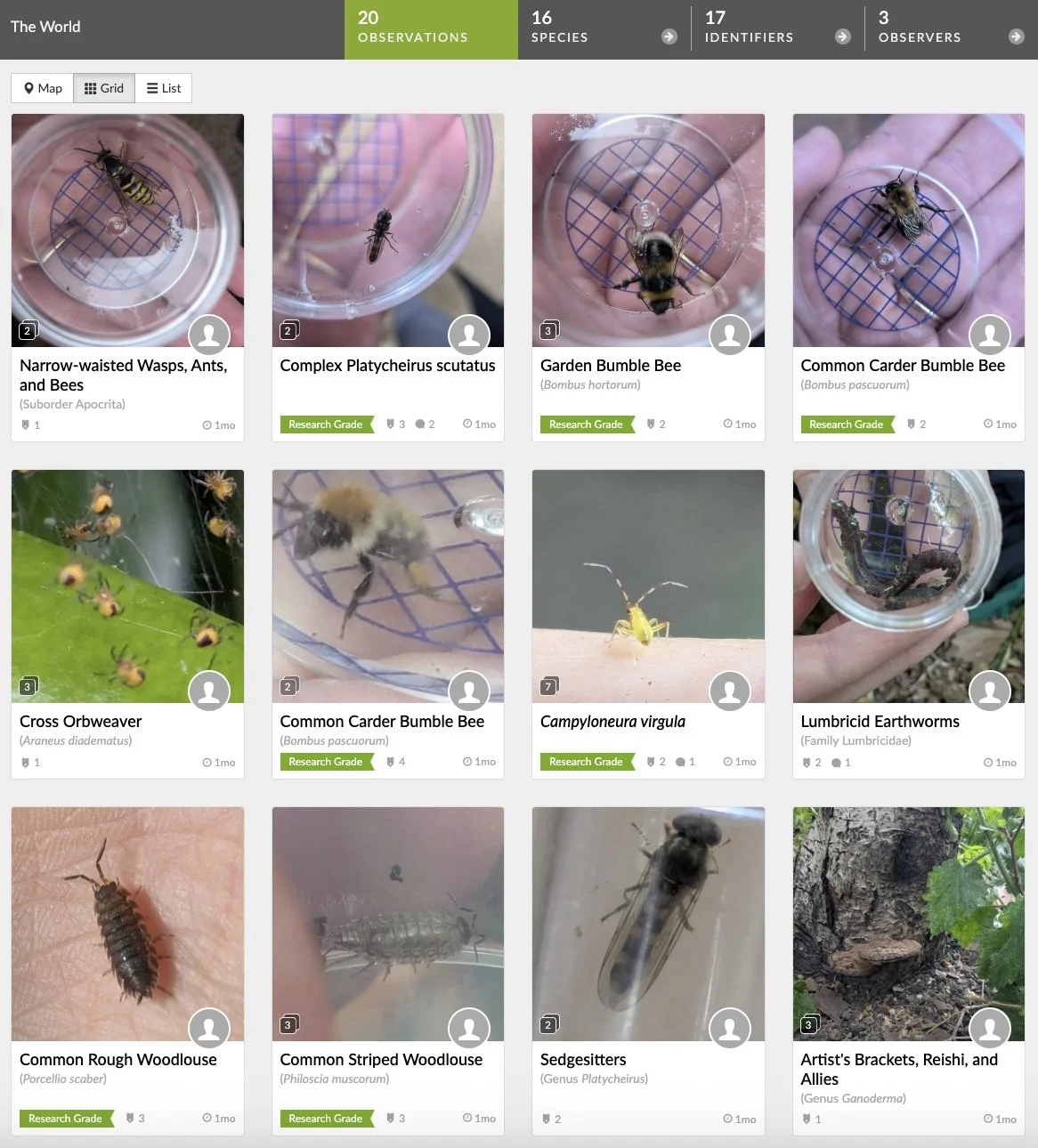
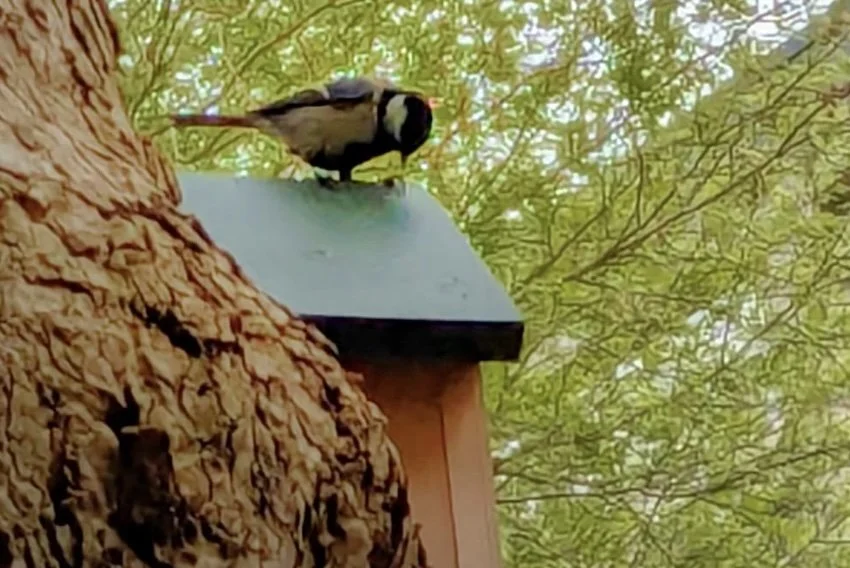
The Queen’s College London team kicked things off at the bottom of the park, dipping the pond and finding water boatmen and mayfly larvae, which was a great start. Others of us meanwhile got cracking looking for birds and insects. We quickly got two sorts of bird, Great Tit and Blue Tit, which we saw carrying food to the nest boxes from which we could hear their fledglings cheeping frantically! At the top of the park we found three types of bumblebee: Clara and I both caught and recorded Bombus pascuorum Common Carder Bees, and Clara got a Bombus pratorum Early Bumblebee with a very nice yellow band at the front of the thorax, and then a Bombus hortorum Garden bumblebee. We also got a Melanostoma scalare Ladder-Backed Hoverfly. A huge wasp was also found by Clara - species yet to be identified! And we got a Muscoidea family House Fly with massive red eyes. Anna, one of the QMUL students, got a cheerful little red Coccinella septempunctata Seven-spotted Lady Beetle, and also found a soft grey Adalia Black-Spotted lady beetle larva, curled up cosily on a geranium leaf. There are several species of ladybird beetle in the UK, all of them good at eating aphids.
After about an hour, the QMUL students moved down to the wildlife area and got down onto hands and knees to sift through the leaves and humus and soil. We got an earthworm of some sort, and potted and photographed it but they are apparently impossible to identify more precisely without killing them, which we didn’t want to do! So of course we let it go. We also got a gorgeous teeny tiny bright-yellow Campyloneura virgula plant bug nymph, which happily sat on a fingernail to be photographed, showing off its stripy antennae like barber-shop poles. Two species of woodlouse were also found, a Philoscia muscorum Common Striped Woodlouse, which true to its name had a stripe on its back, as well as a brownish Porcellio scaber Common Rough Woodlouse. Its name means “scabby little pig”. Poor thing! Woodlice are humble but helpful things, which chew leaf litter and other detritus, playing a big role in the creation of humus, and woodlice themselves are superfoods for other creatures including ground-foraging birds like Blackbirds. Their “scabby” bodies are rich in calcium and a crucial food source especially during the breeding season when female birds are making eggs. We often see Blackbirds flipping up leaf litter in the park, and now we know a bit more about the kind of good things they are finding there.
As the clock passed 5:00pm, we recorded two sorts of fungus, a Ganoderma bracket fungus in the “stumpery” area, and the frilly Trametes Turkeytail fungus that is growing on a couple of the log piles. Some of the younger Friends of St John’s Garden now arrived, and joined in enthusiastically, learning to net and pot insects with the QMUL team, and getting a great Platycheira Sedgesitter hoverfly as well as another House fly. And then right at the end just before the two hours ran out, Seb found a brilliant clump of baby spiders in the sunken garden, bright orange and black, which we think were Araneus diadematus, the Garden Orb-Web Spider.
Altogether, twenty observations made it into the St John’s Garden Spring 2026 iNaturalist bioblitz project, which you can see here. Thank you and bravo everyone! A busy and enjoyable two hours! And - not that they are reading this! - but we are grateful to experts in the iNat community who since the event have been helping us identify some of the wild things that we saw. Our idea is maybe to repeat seasonal Bioblitzes in St John's Garden. We are learning by doing, as ever... See you next time!