
Susanna’s Wildlife Watch - March
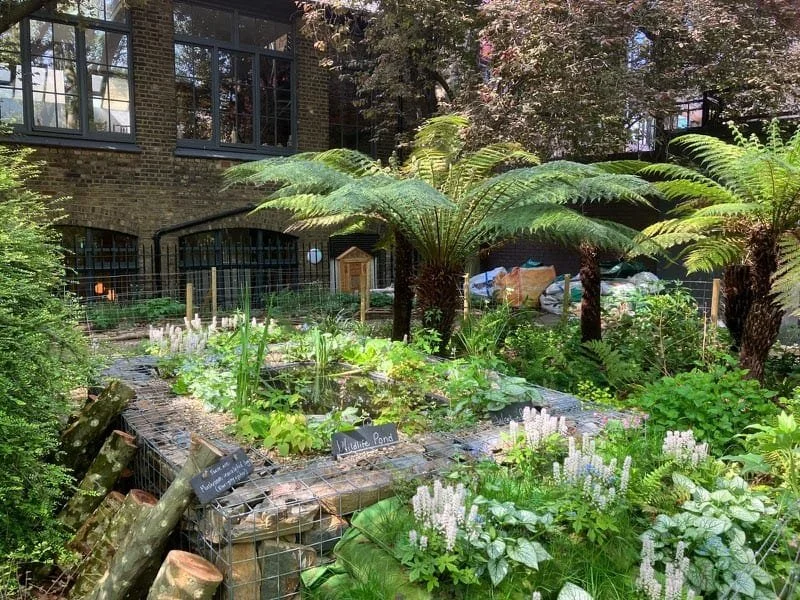
It is now 16 months since the wildlife pond was established in St John’s Garden. We planted the pond initially with Caltha Palustris (marsh marigold or kingcups), Mentha aquatica (water mint) and Iris pseudacorus (Yellow flag iris), then have largely let nature take its course, to see what would happen, and what life would arrive.
We could expect life to arrive in different ways. Microscopic creatures and algae would be blown in by the wind and the rain. Insects such as dragonflies, damselflies, and water boatmen would fly in, finding the pond through seeing light reflected off the surface of the water. Beetles, bugs, frogs, toads and newts just walk to new ponds, on damp nights, apparently detecting water in the dark by scent. And some tiny organisms like daphnia water fleas get carried in on the birds’ legs or feathers, when the birds use the pond for bathing and drinking.
We dip the pond regularly, to see if any new creatures have arrived. Last year, our most exciting find were lesser water boatmen, which we discovered zipping around the pond. Over the winter, things went quiet, but Rosa Goddard of Queens College London still found copepods, microorganisms which sieve out food particles, and are at the bottom of the food chain.
Then a couple of weeks ago, I dipped the pond, and found not only the super little water boatmen again, but I also got some new creatures. They were small pale creatures less than 0.5cm long, and were swimming around in short, darting bursts. They had dark eyes, six legs, and three slender tails. I guessed that they were mayfly larvae, and posted our find on iNaturalist to see if someone would help. An expert in stoneflies and mayflies at the University of Colorado saw my post, and said that yes they are mayfly larvae, in the genus Cloeon, which means they are some of the smallest sort, 'minnow mayflies'.
This was great to know. Mayfly larvae are an indicator species that scores 5 points on the pond health scale, so together with the lesser water boatmen, we had a total of 10 points, our best score yet. The scale we’re using was established by Imperial University and the Natural History Museum.
Apparently mayfly nymphs eat algae and decaying matter, which helps to keep the water clear. They form an important part of the food chain, eaten by fish as well as by dragonfly larvae, aquatic beetles, and frogs, whilst adult mayflies are food for bats and birds. They ‘hatch’ not necessarily in May, but any time from spring to autumn, often all hatch at once, at dawn or dusk. When a nymph is ready to become an adult, it rises to the surface, bursts from its skin, then rests for a minute on the cast skin, before flying upwards. Adult mayflies are delicate-looking insects with membranous wings that they hold upright at rest, like a butterfly. For a day or so the adult mayflies dance around each other above water, in a courtship display. The lifespan of an adult mayfly is short, with some species of mayfly living for only five minutes.
Many writers have written about mayflies. Roman author Pliny the Elder described them on the Black Sea at midsummer, “thin membranes … that live not beyond one day”. We can maybe see them too this year, dancing for a day, above St John’s Garden pond.